




What is HVAC ? Components & Benefits Explained Guide 2026

مقدمة
Most people in Riyadh live inside an HVAC system for 10 hours a day. They just don’t think about it that way.
HVAC stands for Heating, Ventilation, and Air Conditioning. It’s the collective term for every system in a building that controls temperature, humidity, and air quality. In Saudi Arabia, the “H” for heating gets less attention than it deserves, but the “AC” part? That’s life support from May through September.
Honestly, the reason so many building owners and facility managers have trouble with their systems is that nobody ever explained what HVAC actually does at the mechanical level. They buy a unit, they call a technician when it stops working, and they pay a SEC bill that makes them want to sit in the dark. That cycle stops when you understand the basics.
This article breaks it down. No textbook language. Just how it actually works.
What Does HVAC Stand For?
HVAC stands for Heating, Ventilation, and Air Conditioning.
Three separate functions, usually tied together in one integrated system. In GCC countries, most residential installations skip the heating component entirely, or fold it into a heat pump unit that handles both directions. But in large commercial buildings, hospitals, and hotels, all three parts are active year-round and interdependent.
The HVAC definition sounds simple. The engineering behind it is not.
How Does HVAC Work?
At its core, HVAC moves heat. That’s it.
In cooling mode, the system pulls heat from inside the building and dumps it outside. In heating mode, it does the opposite. The medium that carries that heat is refrigerant, a chemical compound that changes state between liquid and gas and absorbs or releases thermal energy as it does.
Here’s how is does HVAC works:
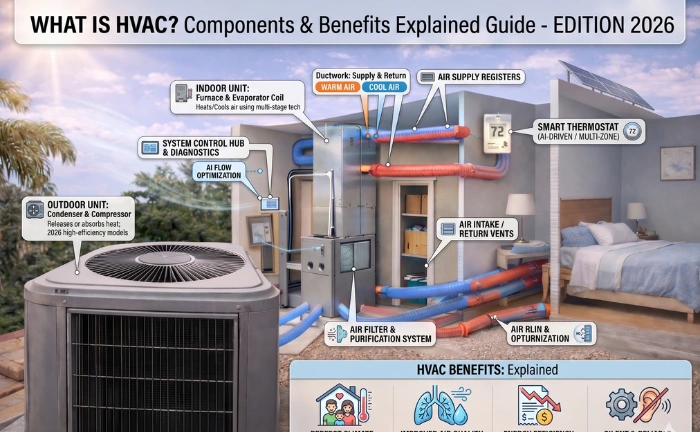
- Warm air from indoors moves across evaporator coils in the air handler.
- The coils absorb heat from the air, and the refrigerant changes from a liquid to a gas.
- That gas heads to the compressor, which essentially squeezes the gas to a smaller volume, and therefore, increases the pressure.
- Now in a smaller volume and at a higher pressure, the gas heads to the coils at a condenser, which depose the now cool refrigerant gas back to a liquid phase.
- The refrigerant once again modified in phase back to a liquid, passes through an expansion valve where its pressure significantly drops.
- The liquid refrigerant is cold again before heading back to the evaporator coils to absorb heat once more.That loop runs continuously while your thermostat is calling for cooling. The blower motor inside the air handler pushes treated air through ductwork and out through vents and registers into occupied spaces.
Simple in concept. Demanding in execution, especially in a climate like Jeddah’s, where ambient temperatures and humidity both fight the system at the same time.
The Main Components of an HVAC System
Understanding the parts makes it much easier to diagnose problems, plan maintenance, and communicate with technicians.
كمبروسر
The refrigeration circuit sees the compressor as its heart. By increasing the pressure of the gas refrigerant, useful temperature levels for the heat exchange process can be achieved. Without a working compressor, everything fails. In Riyadh, it’s a race against time to avoid high head pressures and shorten the life of a compressor.
Need genuine HVAC compressor parts in Saudi Arabia?
Browse compressors, capacitors, contactors, and replacement components stocked locally and ready for fast dispatch.
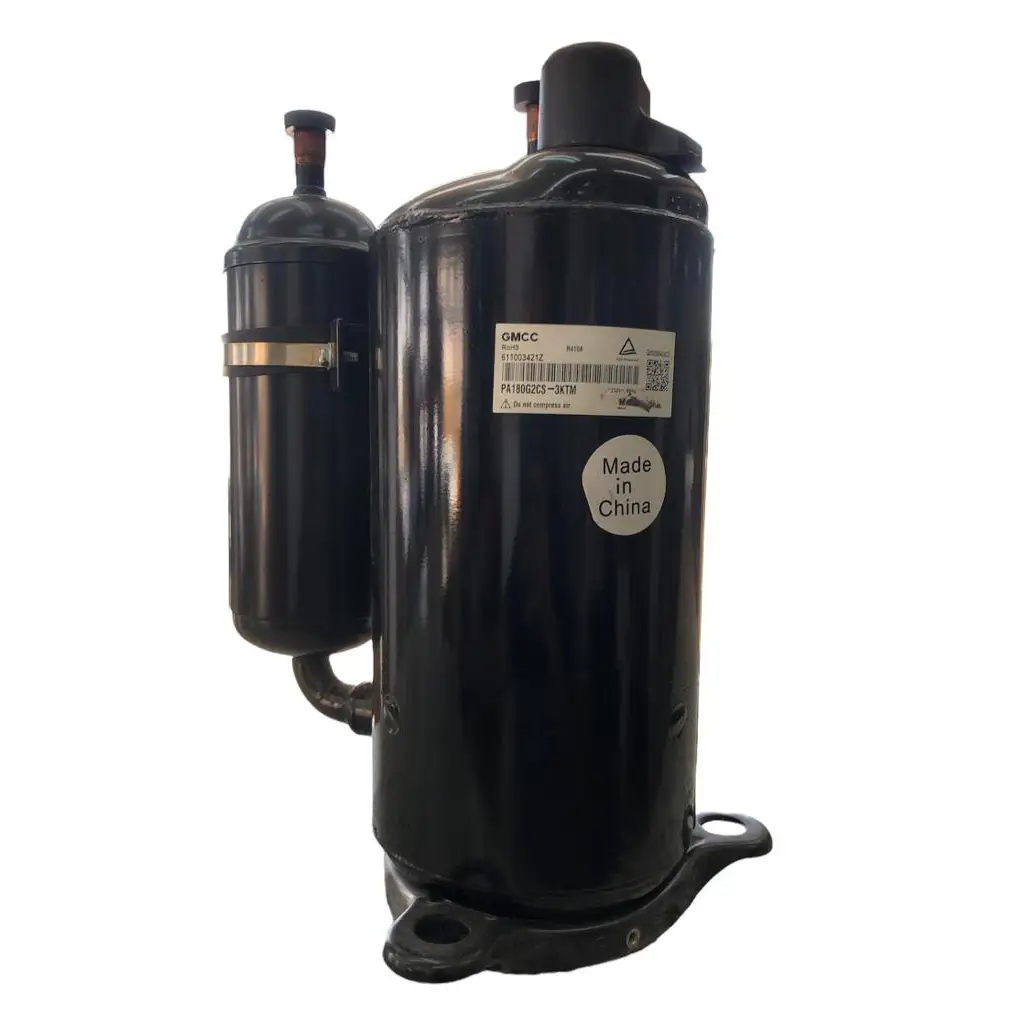
HVAC Compressor Parts
Genuine compressors, capacitors, contactors, and replacement components for commercial and residential HVAC systems.
Shop Now →Evaporator Coil
Located in the indoor/cooling air handler unit, this component is the first to come in contact with cooling or heating air. In Saudi Arabia, dirty evaporator coils are the leading cause of building HVAC system inefficiencies. They ice over, reducing airflow and increasing energy consumption while system comfort level decreases.
Dirty evaporator coils reducing system efficiency?
Shop professional coil cleaners designed to remove dust and buildup without damaging delicate fin coatings.
HVAC Coil Cleaner
Professional-grade cleaning solution that removes dirt and grime while helping preserve coil performance.
Shop Now →Condenser
In split systems, this is the outdoor unit, and in air cooled systems, outside air is drawn through the coils of the condenser by a condenser fan. During a Samal event, a shamal can cause a dusting of the coils, which is why coil cleaning should be on every facility manager’s to-do list.
Dust-covered condenser coils driving up energy costs?
Keep outdoor units operating efficiently with approved HVAC cleaning products and maintenance supplies.
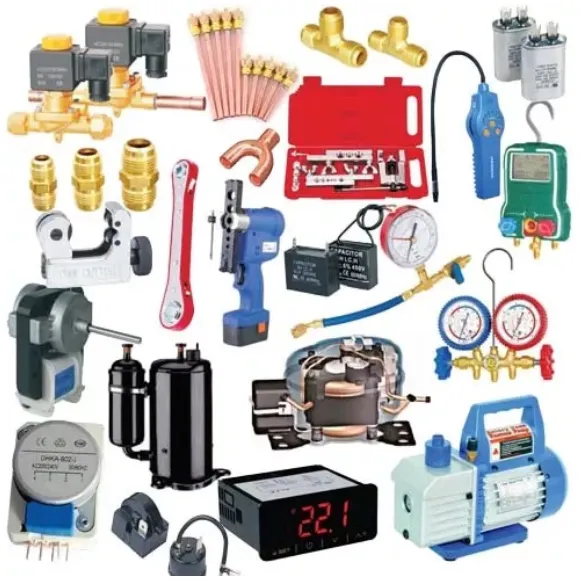
HVAC Spare Parts
Helps maintain condenser efficiency, improve airflow, and reduce unnecessary energy consumption.
Shop Now →Air Handlers
The unit that houses the blower motor and air filter and contains the evap coil. It is the central component of an HVAC system.
Ductwork
The system of pipes that channels air to every room. Leaky ducts in Saudi Arabia waste energy and is reflected in SEC energy bills.
The control point. Building automation systems (BAS) integrate smart thermostats. Field data from facilities that switched smart thermostats and BAS report HVAC energy savings of 20 to 30 percent.
Looking to improve HVAC efficiency and control?
Explore smart HVAC Flexible duct and building automation solutions for commercial and residential applications.

Smart HVAC Flexible Duct
Improve temperature management, reduce energy consumption, and enhance occupant comfort.
Shop Now →Air Filter
Stops dust, sand, and all sorts of particulates before they hit the evaporation coil or even reach the occupied space. In Dammam and the coastal areas, you also face air with salt that eats away and speeds up corrosion on fins and coils. Filtration is key here and more important than virtually anywhere else in the world.
غاز الفريون
غاز الفريون
The working fluid. In Saudi Arabia, R-410A is still widespread with R-32 coming in and becoming the norm with new equipment being imported. Proper charge is everything. Even 10% under charge alters sub-cooling and superheat, reduces capacity and terrible efficiency.
Need refrigerants and charging accessories in Saudi Arabia?
Shop R-410A, R-32, manifolds, charging hoses, leak detectors, and HVAC service tools.
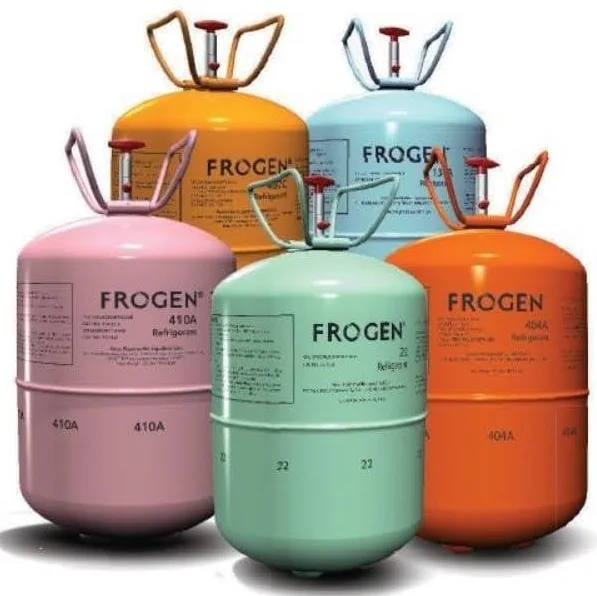
HVAC Refrigerants & Tools
Quality refrigerants and charging accessories for proper system performance and efficiency.
Shop Now →HVAC vs AC: What’s the Difference?
People use HVAC and AC interchangeably. They’re not the same.
Air conditioning is one function within an HVAC system. AC refers specifically to cooling, dehumidification, and air distribution. HVAC is the whole package, including heating and ventilation.
In a Saudi villa, a typical split system wall unit is really just an AC unit. It cools, and some models heat in winter. That’s not a full HVAC system.
A full HVAC system in a commercial building includes fresh air intake, heat recovery ventilators, chilled water distribution, fan coil units, and exhaust systems. Much more complex, and much more energy-intensive if not properly controlled and maintained.
Types of HVAC Systems Used in Saudi Arabia
Split Systems
The most common type in residential and light commercial applications across the Kingdom. One outdoor condenser unit connects to one or more indoor units via refrigerant lines. Low upfront cost, easy to install, widely available. The downside is that multiple separate units mean multiple systems to maintain.
Central Ducted Systems
Used in villas, large apartments, and mid-rise commercial buildings. A single air handler distributes cooling and heating through a network of ductwork. Offers uniform comfort and better filtration potential, but duct integrity is critical. Leaking ductwork is surprisingly common in older Saudi buildings and wastes substantial energy.
Chilled Water Systems
The standard in large commercial projects, hotels, hospitals, and government buildings. A chiller plant produces chilled water that circulates through the building, feeding fan coil units or air handling units in each zone. More efficient at scale, but the plant-side equipment requires serious maintenance expertise.
VRF/VRV Systems
Variable refrigerant flow technology allows a single outdoor unit to serve many indoor units simultaneously, each at different temperatures. Very popular in Saudi commercial and hospitality projects over the last decade. Energy efficient, flexible zoning, and the ability to recover heat from one zone and use it in another.
Packaged Units
A self-contained unit where all components (comp, evap, condenser) sit in a single cabinet, usually rooftop-mounted. Common in retail and light industrial applications. Easy to replace, but rooftop exposure in Saudi summers is hard on these units if preventive maintenance is neglected.
HVAC Maintenance Schedule: What Actually Needs to Happen
Preventive maintenance is where most building owners in Saudi Arabia underinvest and overpay on energy bills.
Quarterly, at minimum:
- Clean condenser coils (monthly during summer, honestly)
- Inspect and clean evap coil
- Check refrigerant charge (superheat and subcooling)
- Inspect belts, bearings, and blower motor
- Replace or clean air filters
- Clear condensate drain lines
Annually:
- Full electrical inspection on all contactors, capacitors, and wiring
- Calibrate thermostats and controls
- Inspect ductwork for leaks
- Lubricate motors and moving parts
- Log system performance data against baseline
In my experience, buildings that follow a quarterly schedule on condenser coil cleaning alone see measurable drops in SEC electricity bills within a single summer season. A clogged condenser is like trying to run with your hand over your mouth. The comp works harder, pulls more amps, runs hotter, and fails sooner.
Common HVAC Issues in Saudi Arabia
The Gulf climate imposes specific failure patterns you won’t read about in a standard HVAC manual.
- High Ambient Temperature Failures: Air-cooled condensers are rated to ASHRAE conditions (35°C outdoor). Riyadh regularly hits 46 to 48°C. That 10 to 13-degree gap forces compressors to work at elevated head pressures, tripping high-pressure cutouts or, worse, degrading lubricant and burning bearings.
- Shamal Dust Blockage: A severe shamal storm can halve condenser airflow in 24 hours. Many facility managers don’t check coils after dust events. They just watch efficiency drop and assume the equipment is aging.
- Salt Corrosion in Coastal Zones: In Jeddah and Dammam, salt-laden air attacks aluminum fins and copper tubes. Without protective fin coating or regular washing with pH-neutral cleaners, fin deterioration accelerates and causes refrigerant leaks within 3 to 5 years.
- Refrigerant Overcharge: As common as undercharge in Saudi Arabia. Technicians without proper gauges guess the charge, add refrigerant “just to be safe,” and end up flooding the compressor with liquid. Liquid slugging kills compressors fast. Invest in a proper manifold gauge set and train your team to use it.
- Poor Ductwork Design: In older buildings, ducts were sized by eye or by habit rather than ACCA Manual D calculations. Undersized supply ducts create velocity noise and poor room distribution. Oversized return ducts collapse on themselves or draw in unconditioned air. Both scenarios destroy comfort and inflate bills.
HVAC and Vision 2030: Efficiency Is Now Mandatory
Saudi Arabia’s Tarsheed program and SASO energy efficiency standards are reshaping the HVAC procurement landscape. SASO requires minimum energy efficiency ratios (EER) for air conditioners sold in the Kingdom. Anything below threshold can’t legally be sold or installed in new projects.
Vision 2030’s sustainability goals push further. Green building certifications (LEED, Mostadam) now factor into major commercial projects, and HVAC accounts for 50 to 70 percent of a building’s total energy consumption in hot climates. The days of buying the cheapest split system and ignoring the lifecycle costs are ending, especially for procurement teams managing government-funded projects.
Is HVAC Heating or Cooling?
Both. And ventilation.
The mistake most people make is treating HVAC as a synonym for “air conditioning.” In Saudi Arabia, that confusion is understandable because cooling dominates 9 months of the year. But a real HVAC system handles all three functions: it cools in summer, heats in winter (yes, Riyadh nights in January can drop to 6°C), and ventilates year-round to maintain acceptable indoor air quality.
Modern heat pumps handle both heating and cooling in a single unit by reversing the refrigeration cycle direction. They’re increasingly common in Saudi projects because they’re more energy-efficient for heating than electric resistance elements.
Expert Insight from the Field
Here’s something most HVAC guides won’t tell you: the system that looks most impressive on paper is not always the best choice for a Saudi project.
VRF systems are efficient and flexible, but if your maintenance team doesn’t have factory training on that specific brand’s control software, you’ll spend a fortune on service calls trying to decode fault codes. Split systems are simple, parts are everywhere, and any technician in Riyadh can troubleshoot them. That has real value.
Match the system complexity to your team’s capability. A poorly maintained VRF system loses its efficiency advantage within 18 months. A properly maintained ducted split system can outperform it on total cost of ownership.
Truth is, the equipment is often the least important variable. Installation quality, duct integrity, and maintenance discipline determine whether a system performs well or costs you every month.
Find the Right HVAC Equipment for Saudi Arabia at cool.sa/
Whether you're a facility manager replacing a burned-out compressor in Riyadh, an MEP contractor sourcing VRF components for a Jeddah hotel fit-out, or a building owner finally upgrading that aging split system before summer hits, cool.sa/ has what you need, in stock, in the Kingdom.
No waiting on international shipments. No guesswork on SASO compliance. Just the right equipment, from brands that hold up in Gulf conditions, with technical support that understands what 48-degree ambient temperatures actually do to a refrigeration circuit.
Browse the full HVAC catalog at cool.sa/ and get your order in before the next Riyadh summer catches you short.
Browse the Full HVAC Catalog →خاتمة
HVAC isn’t a mystery. It’s thermodynamics, airflow management, and mechanical discipline, applied to the challenge of keeping people comfortable in one of the harshest climates on earth.
Understanding the basic refrigeration cycle, knowing which components matter most, and following a real maintenance schedule will do more for your SEC bills and system longevity than any equipment upgrade.
If you’re specifying, procuring, or maintaining HVAC equipment in Saudi Arabia, cool.sa/ stocks components, refrigerants, air handlers, condensers, controls, and everything else your system needs. Browse the full HVAC equipment catalog to find what you’re looking for.
الأسئلة الشائعة
What does HVAC stand for?
HVAC stands for Heating, Ventilation, and Air Conditioning. It refers to the complete system responsible for controlling indoor temperature, humidity, air circulation, and overall air quality within a building.
Is HVAC the same as air conditioning?
No. Air conditioning is only one component of an HVAC system. HVAC also includes heating equipment such as furnaces, heat pumps, or heating coils, as well as ventilation systems that provide fresh air intake, exhaust, and filtration.
What are the main types of HVAC systems used in Saudi Arabia?
The most common HVAC systems in Saudi Arabia include split systems, central ducted systems, chilled water systems, VRF/VRV systems, and rooftop packaged units.
How often should HVAC systems be serviced in Saudi Arabia?
HVAC systems should be serviced at least quarterly. Due to high temperatures, dust storms, and coastal salt exposure, some maintenance tasks may be required monthly during peak summer periods.
What is the difference between a heat pump and an air conditioner?
A heat pump can both cool and heat a building by reversing the refrigeration cycle. A standard air conditioner only provides cooling.
How much does HVAC cost in Saudi Arabia?
Costs vary based on system type and building size. Split systems may start around SAR 1,500–3,000 installed, while central systems and commercial projects vary significantly.
Why is my HVAC system not cooling properly in summer?
Common causes include dirty condenser coils, low refrigerant charge, clogged filters, undersized equipment, or leaking ductwork.
 English
  العربية