




Washing Machine Parts and Functions: Every Part, What It Does and How It Fails

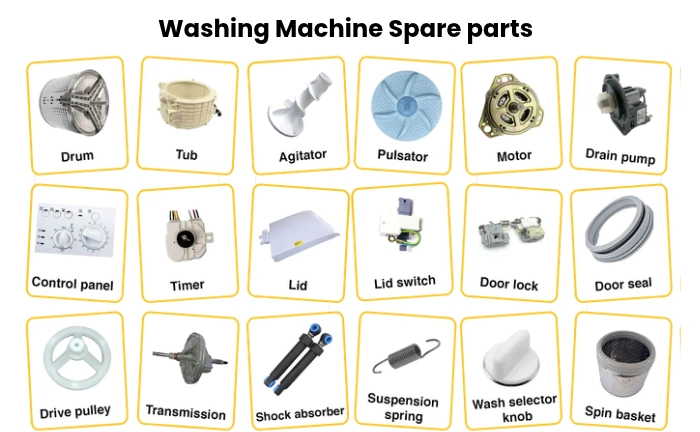
Most washing machine faults trace back to one of about twenty parts. Knowing which part does what is the fastest way to stop guessing. This guide covers the main parts of automatic front-load and top-load washers, then the very different parts inside a twin tub. For each part you get its job, the symptoms of failure, and the cheaper causes to rule out before you buy anything.
Washing machine parts at a glance
Every automatic washer has three systems:
- Water system: inlet valve, water level sensor, drain pump and hoses.
- Drive system: motor, belt or direct drive, gearbox or clutch on top-loaders, and drum bearings.
- Control and safety system: control board, door lock or lid switch, door seal and shock absorbers.
A twin tub replaces most of the electronics with mechanical timers, two motors and a manual drain selector.
Main parts of an automatic washing machine
Water system
Water inlet valve
The inlet valve is an electric solenoid valve. It opens and closes the water supply when the control board tells it to. Valves come as single, dual or triple units, one outlet per detergent or softener path. Some run on mains voltage and others on 12 V DC, as on many recent LG models.
- Symptoms: no fill, slow fill, or filling while the machine is off. Many LG washers show an IE/1E code.
- Rule out first: a closed tap, low water pressure, or a blocked mesh screen at the hose inlet.
- When buying: match the voltage and the part number, for example LG 5221ER1003N or Samsung DC62-00266E.
Need a new water inlet valve?
Match the voltage and outlet count of your old valve. These are a few of the valves we carry:
Water level sensor (pressure switch)
The sensor reads air pressure in a small tube connected to the tub. That tells the board how much water is inside.
- Symptoms: over- or under-filling, stopping at rinse, or refusing to spin because the board thinks the tub is still full.
- Rule out first: a kinked or clogged sensor tube.
Drain pump and filter
The drain pump pushes water out to the drain hose. Most front-loaders have a coin trap or filter behind a small panel at the bottom front.
- Symptoms: standing water, humming without draining, or the cycle stopping before spin. LG shows OE.
- Rule out first: the filter, a kinked drain hose, or a blocked standpipe. These cause a large share of “not draining” calls. See why a washing machine stops draining.
Drain pump or filter worn out?
Try cleaning the filter first. If the pump still hums without draining, here are some replacements:
Inlet and drain hoses
Cracked hose ends, kinks behind the machine and drain hoses mounted too high cause leaks and slow draining. They are cheap fixes, so check them before replacing anything bigger.
Replacing a hose?
These are cheap fixes that solve many leaks and slow-drain problems:
Drive system
Motor and carbon brushes
The motor turns the drum or the pulsator. Many belt-driven front-loaders use a brushed motor, and its carbon brushes wear out. Direct-drive washers have neither brushes nor a belt.
- Symptoms: no movement, weak spin, humming or a burning smell.
- Rule out first: worn brushes, which cost far less than a motor, a snapped belt, and the board’s motor output.
Weak spin or sparking motor?
Worn carbon brushes are often the cause, and they cost far less than a new motor.
Drive belt and pulley
The belt carries drive from the motor pulley to the drum pulley. The classic sign of a broken belt is a motor you can hear running while the drum stays still. A rubbery burning smell is another sign. Check this cheap part before blaming the gearbox or motor.
Gearbox and clutch (top-loaders)
On top-loaders, the gearbox or transmission and the clutch send motor drive to the pulsator or agitator during the wash. They then lock the whole basket for the spin.
- Symptoms: the motor runs but the basket or pulsator doesn’t move, grinding or clicking, or oil or water leaking under the tub.
- When buying: gearboxes are model-specific. Match the brand, the model, the shaft shape and the spline count, not just the general look.
Looking for a top-load gearbox?
Gearboxes are model-specific. Send us a photo of your old gearbox to check the shaft and splines before you order.
Drum bearings and tub seal
The bearings carry the drum shaft. The seal keeps water away from them.
- Symptoms: a loud roar during spin, drum play you can feel by hand, or rust streaks and leaks at the back.
- Note: on front-loaders, replacing bearings means splitting the tub. This is a technician-level job.
Control and safety system
Control board
The control board runs the programs, reads the sensors and switches the valve, pump and motor. It is usually the most expensive part on an automatic washer.
- Symptoms: a dead panel, buttons that don’t respond, or random error codes.
- Rule out first: the cheaper parts that throw the same codes, such as the door lock, wiring and sensors.
Door lock (front-load) and lid switch (top-load)
The door lock latches the door and confirms to the board that it is closed before the cycle starts. It normally stays locked for a minute or two after the cycle ends. On top-loaders, a lid switch or lid lock stops the spin when the lid opens.
- Symptoms: the machine won’t start with the door shut, the door won’t open after the cycle, a door code such as LG’s dE, or a top-loader that never spins.
- When buying: locks differ by brand. Samsung, LG, Beko and Ariston use different shapes and connectors.
Door lock or lid lock not working?
Pick the lock for your brand:
Door boot and shock absorbers
- Door boot (gasket): seals the front-load door. A torn boot leaks at the front and holds mould.
- Shock absorbers: damp drum movement on front-loaders. Top-loaders use suspension rods instead. When they wear, the machine shakes hard or walks across the floor even with a balanced load.
Machine shaking or walking?
If the load is balanced and the feet are level, the shock absorbers are the likely cause.
Twin tub washing machine parts
A twin tub has a wash tub and a separate spin tub, each driven by its own motor. Mechanical timers do the job of a control board, so most faults are easy to trace once you know which tub is failing. For how twin tubs work and how to size one, see cool.sa’s twin tub washing machine guide.
Wash timer and spin timer
- Wash timer: usually up to 15 minutes. It also reverses the pulsator’s direction.
- Spin timer: usually up to 5 minutes.
A failed timer means the tub won’t start, turns only one way, or never stops. A replacement must match the old timer’s wire count (2, 3, 5, 6 or 7) and its fitting size (large or small).
Find your twin tub timer
Count the wires on your old timer and check its fitting size, then choose the match:
Motors and run capacitors
Each motor has a run capacitor that gives it the starting push. If you hear a hum but the pulsator or spin basket won’t turn, or turns slowly, test the capacitor first. It is cheaper than the motor and fails more often.
Gearbox, spin seal and spin brake
Some twin tubs, such as Hitachi models, use a gearbox to drive the pulsator. In the spin tub:
- Spin seal: keeps water off the shaft. A failed seal shows up as a leak under the spin tub.
- Spin brake: stops the basket when the lid opens. If the basket keeps turning with the lid open, or drags, check the brake and its cable.
Twin tub gearbox or spin seal
Parts for Hitachi and other twin tubs:
Drain selector and spin lid switch
- Drain selector or switch: opens the wash-tub drain valve. If water won’t drain, or drains during the wash, check this before anything else.
- Spin lid switch: cuts power to the spin motor when the lid opens. If it fails, the spin tub never runs.
Twin tub not draining?
If the drain selector or switch has failed, this is the part to replace:
Automatic vs twin tub parts: what’s different
| Part | Automatic | Twin tub |
|---|---|---|
| Control | Electronic board and programs | Separate mechanical wash and spin timers |
| Motor | One motor (brushed or direct drive) | Wash motor + spin motor, each with a capacitor |
| Water in | Electric inlet valve (single, dual or triple) | Usually filled from the tap by hand or hose |
| Drain | Drain pump + filter | Drain valve opened by a selector or switch |
| Safety | Door lock (front) or lid lock (top) | Spin lid switch + spin brake |
| Drive | Belt, direct drive, or gearbox and clutch (top) | Belt; some models use a gearbox |
Symptom checker: which part is likely at fault
| Symptom | Likely parts | Check first |
|---|---|---|
| Won’t fill | Inlet valve, control board | Tap, water pressure, inlet mesh screen |
| Won’t drain | Drain pump; drain selector on a twin tub | Pump filter, hose kinks, standpipe (more on not draining) |
| Won’t spin, or spins weakly | Door or lid lock, belt, gearbox or clutch, motor, spin timer | Load balance, overloading, whether it drained |
| Motor runs, drum doesn’t | Belt, gearbox or clutch | Belt first, as the cheapest |
| Hums, won’t turn | Capacitor, motor, or drain pump (if humming at drain) | Capacitor on twin tubs; debris in the pump |
| Roars on spin | Bearings, shock absorbers | Foreign object between the drums; level floor |
| Shakes or walks | Shock absorbers or suspension rods | Load balance, levelling feet |
| Leaks | Door boot, hoses, tub seal, pump | Exact leak location, hose clamps, detergent dose |
| Won’t start at all | Control board, door lock; timer on a twin tub | Plug, socket, door fully closed |
| Door won’t open | Door lock | Wait 2 minutes after the cycle; check the water has drained |
Finding the right replacement part
Most returns happen because a part looks the same but isn’t. Before you order:
- Photograph the rating label. It is usually inside the door rim, on the side or on the back, and shows the brand and model number.
- Photograph the old part from several angles. Include its printed part number, the connector and the wire count.
- Match the key specs: the voltage (220 V or 12 V DC), the number of valve outlets, the timer wire count, and the gearbox shaft shape.
- Ask before you buy. cool.sa stocks washing machine spare parts for automatic and twin-tub machines. Send the label and part photos on WhatsApp +966 54 066 3777 and the team will help confirm the match.
Repair or replace the whole machine?
Replace the part when the symptoms match it and you have ruled out the simple causes above. Most water, drain, belt, timer and capacitor faults are worth fixing.
If two major parts fail together, compare the total parts and labour cost with a new machine before deciding. Examples are a control board plus a motor, or bearings plus the tub on an older washer. For any electrical fault, or a leak near wiring, unplug the machine and call a technician.
FAQ
Q1. What is the most expensive part to replace on a washing machine?
On automatic washers it is usually the control board, followed by the motor and the tub-and-bearing assembly. That is why the cheaper parts that cause the same symptoms should be checked first.
Q2. What is the most common washer repair?
Drain problems (a clogged filter or a failed pump) and spin problems (a door or lid lock, a belt, or an unbalanced load) are among the most frequent.
Q3. Why is my washing machine not spinning but the motor is running?
On belt-driven machines, check the belt. On top-loaders, the gearbox or clutch is the next suspect.
Q4. Are automatic and twin tub parts interchangeable?
Generally no. Timers, run capacitors and spin lid switches are twin-tub parts. Control boards, electronic inlet valves and drain pumps belong to automatic machines.
Q5. Do error codes mean the same thing on every brand?
No. Codes are brand-specific. For example, on LG OE is a drain fault and IE is a water inlet fault. Check your manual before blaming a part.
Q6. How do I find the right part number?
Use the number printed on the old part, or look it up from the model number on the machine’s label. If neither is readable, a photo of both usually settles it.
Not Sure Which Part Fits Your Machine?
Send a photo of the old part and your machine’s rating label on WhatsApp 0540663777, and we’ll confirm the match before you order. Visit our Riyadh (Ghirnata and Yarmuk) and Khamis Mushait (Atud) branches, with delivery across the Kingdom.
 English
 العربية